During a catastrophic Sev-1 outage, the loudest engineer in the room is rarely the most effective. The engineers who consistently resolve complex crises are not just technically proficient; they possess radical emotional regulation, structured deductive reasoning, and the ability to project calm authority across panic-stricken stakeholders.
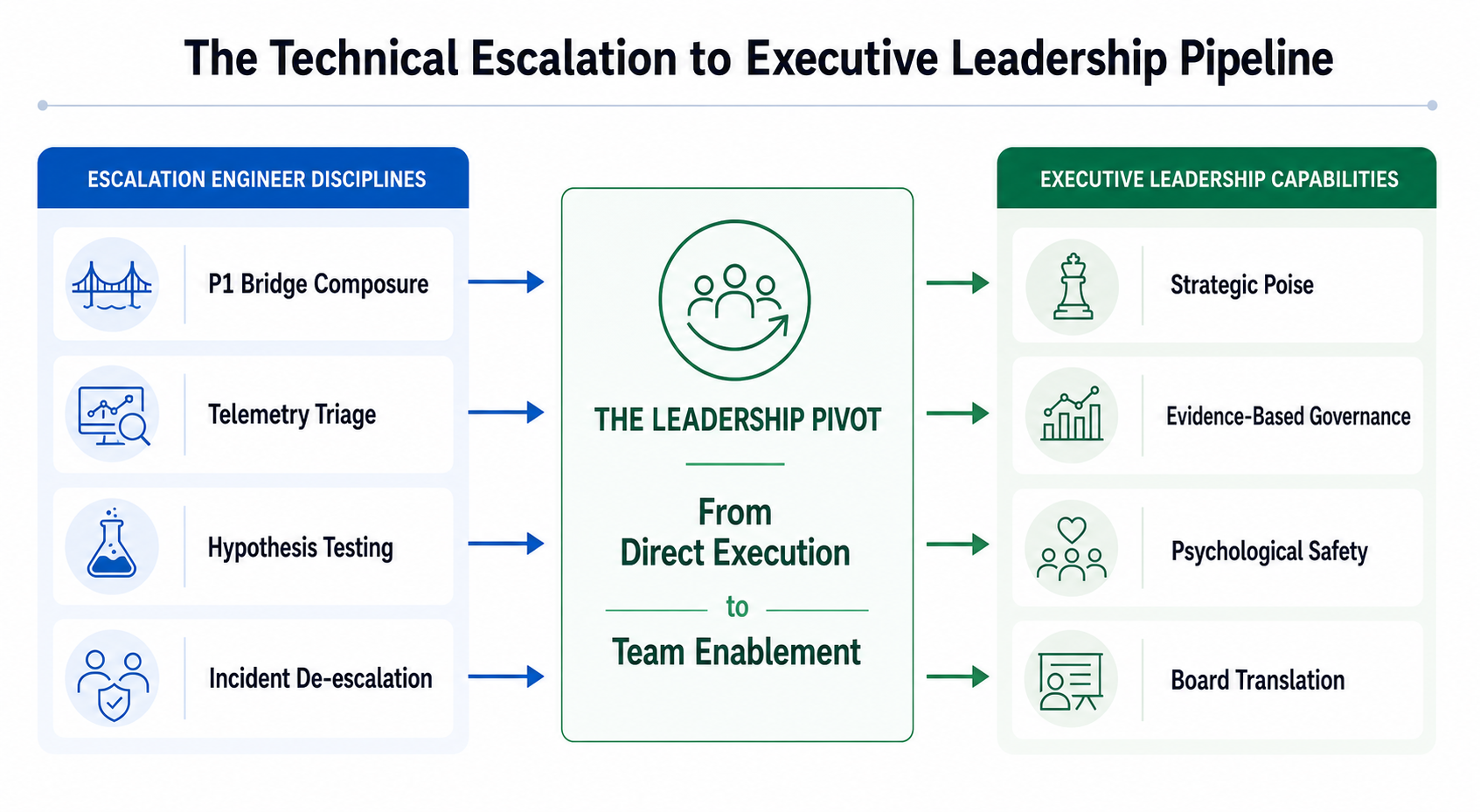
These exact traits form the foundation of exceptional executive technology leadership. Transitioning from a senior escalation engineer to an engineering leader requires pivoting from solving technical anomalies personally to building the organizational conditions, psychological safety, and decision architectures that empower teams to execute without friction.
Crisis Cadence Interval
Time required for an escalation leader to establish command and set situational briefing cadences.
Evidence-Based Triage
Zero production changes permitted without verifiable pre-incident telemetry and rollback paths.
Team Retention Multiplier
Retention rate of technical teams led by leaders with direct escalation engineering backgrounds.
1. The Translation Matrix: Crisis Engineering to Executive Leadership
The high-pressure mental models developed during major outages map directly onto organizational leadership capabilities:
| Crisis Engineering Skill | Operational Context | Leadership Translation | Executive Business Impact |
|---|---|---|---|
| Triage Composure | Filtering 50 simultaneous red alarms during an outage. | Emotional regulation and objective risk assessment under market uncertainty. | Prevents knee-jerk strategic pivots and team panic during downturns. |
| Hypothesis-Driven Debugging | Formulating testable theories based on log anomalies. | Evidence-based decision-making and scientific organizational experiment design. | Replaces corporate politics and subjective opinions with measurable telemetry. |
| Stakeholder Translation | Translating raw packet captures into C-level downtime estimates. | Executive narrative synthesis and clear board communication. | Secures budget funding and protects engineering credibility across the C-suite. |
| Post-Mortem Blamelessness | Investigating system flaws rather than scapegoating people. | Psychological safety cultivation and continuous learning culture design. | Drives early risk identification and eliminates fear-based information hiding. |
“A crisis bridge does not care about your title; it only responds to evidence, clarity, and composed decision-making. Leadership in modern technology organizations functions under the exact same physics.”
2. The Critical Trap: From Solver to Enabler
The primary failure mode of former escalation engineers stepping into management is the temptation to grab the keyboard during every team disruption. When a leader acts as the ultimate escalation solver, they stunt team development and recreate themselves as a massive operational bottleneck.
- Resist Keyboard Hijacking: Ask Socratic debugging questions ('What signal contradicts your current hypothesis?') instead of executing the fix directly.
- Define Blast Radiuses: Grant frontline engineers explicit autonomy to execute operational decisions where failure impact is bounded.
- Codify Post-Crisis Learnings: Ensure every major escalation produces an updated runbook or architectural standard within 72 hours.
Escalation Leadership Transition Checklist
- Measure your leadership success by how few escalations require your direct technical intervention.
- Mandate structured 15-minute briefing intervals during all major operational incidents.
- Conduct blameless reviews focused strictly on telemetry blind spots and system resilience gaps.