Deploying Artificial Intelligence in IT operations without architectural boundaries creates unpredictable failure modes. Treating Large Language Models (LLMs) or neural networks as autonomous decision-makers in production environments inevitably leads to hallucinated configurations, unvetted script executions, and silent security breaches.
AI belongs in IT operations as an intelligence augmentation engine, not an unmonitored administrator. By leveraging machine learning for telemetry correlation, log summarization, and predictive anomaly detection while reserving write access, architectural changes, and risk acceptance strictly for authenticated human engineers, operations teams achieve radical speed without sacrificing governance.
Log Synthesis Latency
Time required for AI models to summarize 10,000+ distributed event logs into plain incident context.
Human-in-the-Loop Gate
Proportion of production configuration changes requiring mandatory human cryptographic approval.
Triage Cognitive Load
Reduction in engineer time spent manually parsing raw telemetry during high-severity bridges.
1. The AI Operational Responsibility Matrix
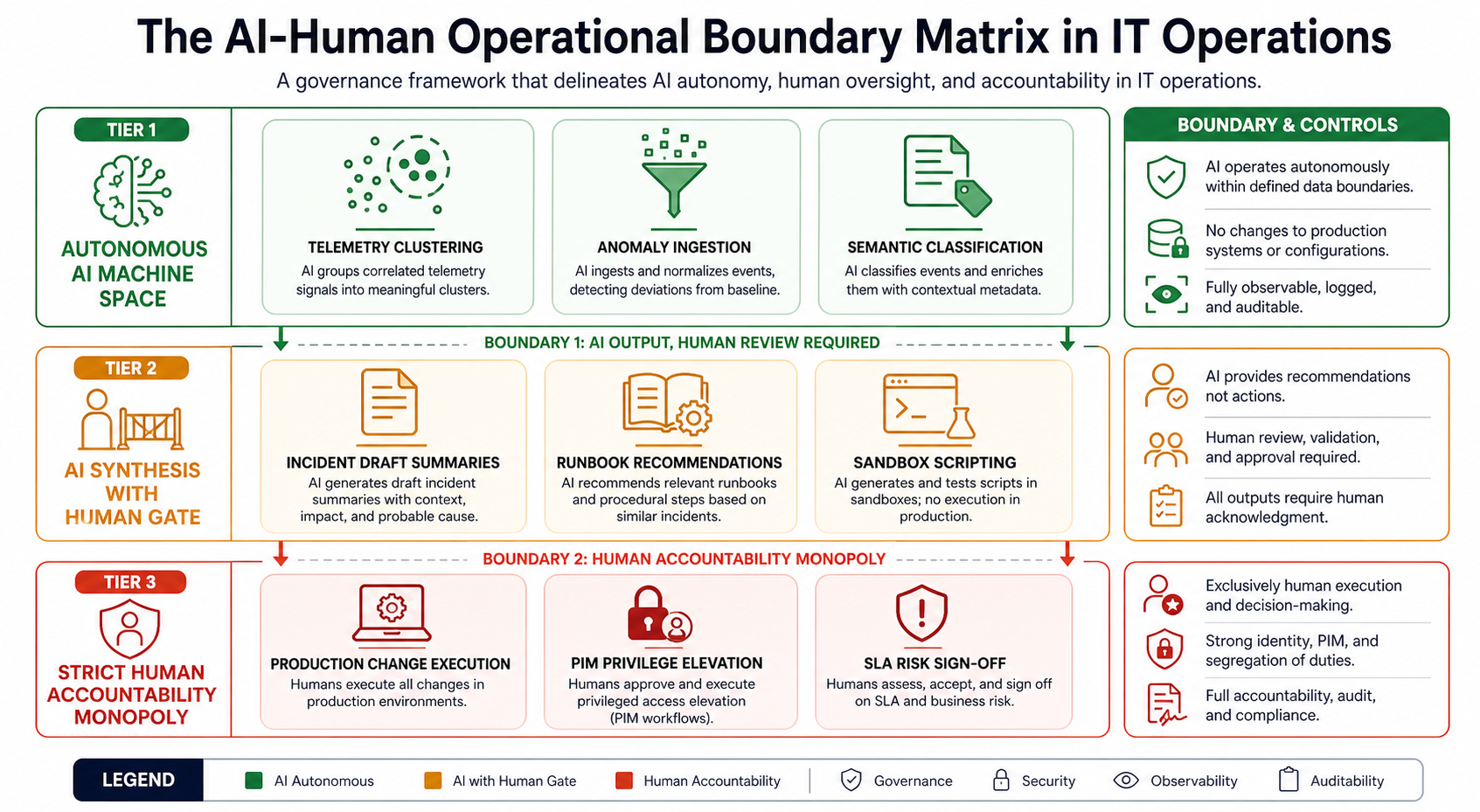
To safely integrate AI into daily IT workflows, leadership must establish clear boundaries between autonomous AI capabilities and mandatory human oversight:
| Operational Domain | AI Autonomous Capability (Green Light) | AI Assist / Human Gate (Yellow Light) | Strict Human Monopoly (Red Light) |
|---|---|---|---|
| Telemetry & Logging | Ingestion, pattern clustering, deduplication, and anomaly detection. | Drafting incident summaries and root-cause hypotheses for review. | Final determination of systemic incident root-cause. |
| Service Desk & Triage | Semantic ticket categorization, priority tagging, and user sentiment analysis. | Drafting email responses and assembling diagnostic runbooks. | Customer contract commitments and ticket scope exception approvals. |
| Configuration & Changes | Static syntax validation and regression dependency mapping. | Automated script generation inside isolated, sandboxed test environments. | Production deployment execution, firewall rule updates, and schema changes. |
| Access & Governance | Anomaly detection on user login telemetry and risk scoring. | Recommending access package deprecations based on activity. | Role elevation approvals (PIM) and security boundary exceptions. |
“AI can synthesize ten thousand logs in thirty seconds, but it cannot own the fiduciary, legal, or operational consequences of taking down a production database. Accountability cannot be delegated to an algorithm.”
2. The Four Pillars of Safe Operational AI Integration
- Read-Only Telemetry Ingestion: Restrict operational AI models to read-only service principals; never grant write or execution credentials directly to generative LLM agents.
- Grounding in Validated Data: Anchor AI retrieval mechanisms exclusively to verified internal Standard Operating Procedures (SOPs) and golden architectural documentation.
- Cryptographic Approval Auditing: Ensure all human change authorizations executed following AI recommendations are immutably logged with user identity, timestamp, and justification.
- Continuous Model Drift Auditing: Review automated classification accuracy monthly to identify model degradation and prevent false-positive alert suppressions.
Operational AI Safety Checklist
- Verify that zero AI agents have direct write access to active production directory or hypervisor APIs.
- Implement an approval gate requiring engineer confirmation before any AI-drafted response is dispatched to clients.
- Enforce strict data sanitization pipelines stripping client PII, passwords, and secrets before passing telemetry to external LLM endpoints.