Trust is rarely built through charismatic speeches or all-hands presentations. In technical and engineering organizations, trust is earned or destroyed through quiet, predictable micro-behaviors: how a leader reacts when an engineer admits a catastrophic mistake, whether deadlines are negotiated with data or enforced by mandate, and whether bad news is met with curiosity or punishment.
When psychological safety is absent, risk does not disappear—it hides. Engineers conceal architectural debt, downplay critical security vulnerabilities, and delay reporting milestone slippages until minor oversights compound into public disasters. Trusted leadership establishes the behavioral safety required for rapid truth-telling.
Early Risk Detection
Frequency of proactive vulnerability reporting in high-psychological-safety teams.
Bad-News Latency
Average time between an engineer identifying a failure and alerting management.
Regretted Attrition
Reduction in voluntary senior engineering turnover under consistent leaders.
1. The Behavioral Micro-Actions of Trust
| Leadership Trigger | Low-Trust Reaction (Erodes Safety) | Trusted Leadership Behavior (Builds Safety) | Organizational Consequence |
|---|---|---|---|
| Engineer Reports a Outage Error | "How could you let this happen? Who approved this change?" | "What systemic guardrails failed, and how do we stabilize production right now?" | Normalizes blameless transparency and accelerates recovery speed. |
| Technical Uncertainty Raised | "I need certainty, not excuses. Make it work." | "What data do we need to test to reduce this architectural uncertainty?" | Eliminates guessing and prevents catastrophic unvetted deployments. |
| Missed Sprint Commitment | Enforces uncompensated overtime and issues public reprimands. | Conducts capacity retrospective to identify estimation blind spots. | Preserves team morale and improves future delivery predictability. |
| Dissenting Opinion Voiced | Defensive dismissal; views disagreement as insubordination. | "Walk me through what you see that contradicts my current assumption." | Uncovers blind spots and builds authentic consensus. |
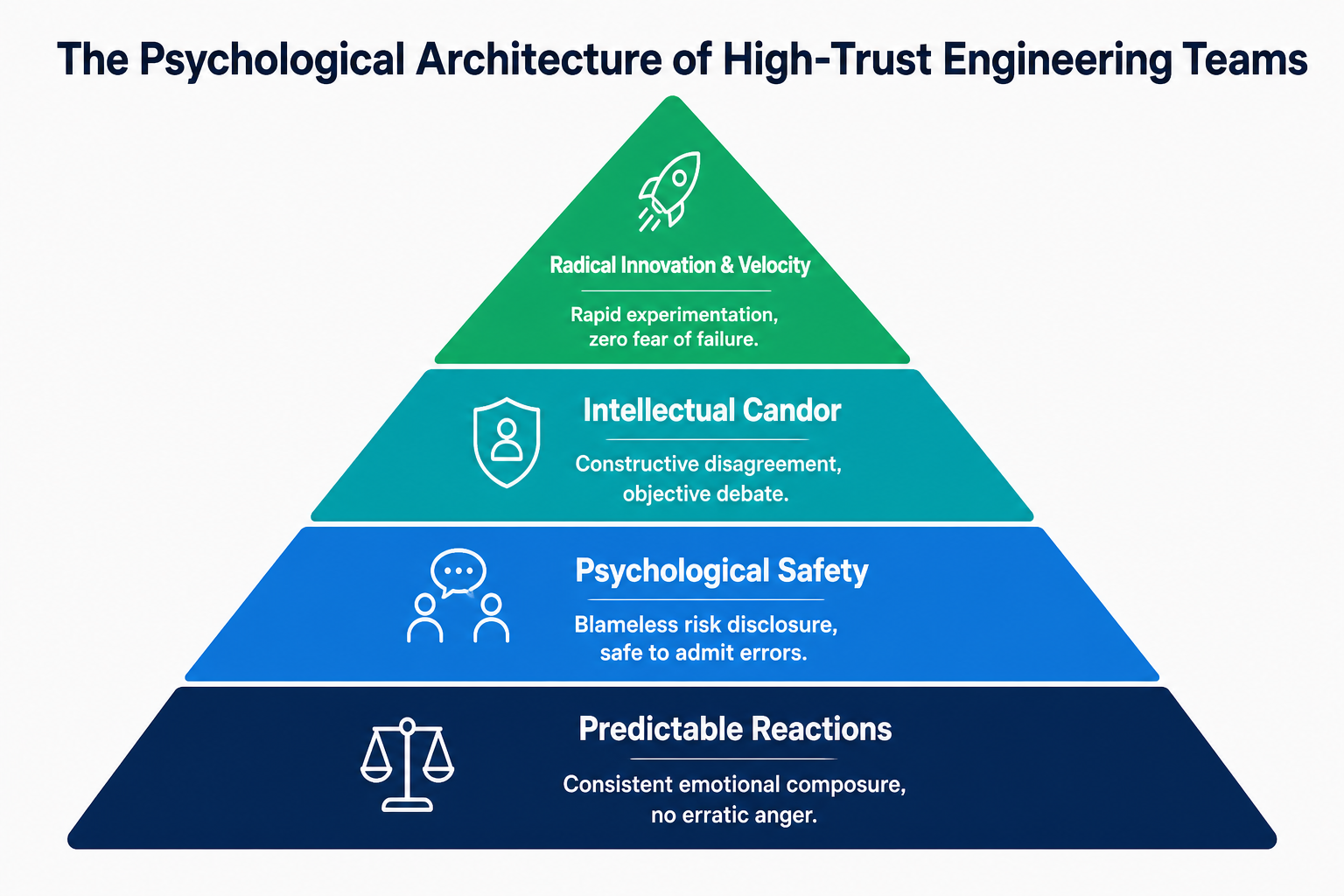
“The speed of an engineering team is bounded by the speed at which bad news travels upward. If bad news is punished, leadership will only learn about problems when they explode in production.”
2. The Four Pillars of Behavioral Consistency
- Predictable Emotional Baseline: Engineers should never have to gauge a leader's mood before deciding whether to disclose an operational crisis.
- Public Credit, Private Accountability: Praise team contributions publicly; deliver performance critique and corrective guidance in strict 1-on-1 settings.
- Transparent Context Sharing: Explain the commercial, financial, and strategic reasons behind unpopular executive decisions rather than issuing top-down edicts.
- Admitting Leadership Fallibility: Regularly acknowledge when executive assumptions were proven incorrect by operational data.
Psychological Safety Audit Checklist
- Track how often junior engineers challenge senior proposals during architecture design reviews.
- Measure the time lag between when an operational incident begins and when leadership is notified.
- Ensure 1-on-1 meetings dedicate at least 50% of time to engineer-driven topics and listening.