Conventional leadership literature loves clean case studies where ethical clarity matches commercial victory. In the post-apocalyptic narrative of *The 100*, leaders never encounter frictionless win-win scenarios. Instead, they operate in extreme resource scarcity where survival demands selecting between catastrophic losses—forcing leaders to govern without the luxury of moral purity.
The series serves as a stark case study in high-stakes governance under existential threat. Whether managing life-support quotas on the Ark or navigating existential tribal conflict on the ground, leaders like Clarke Griffin and Marcus Kane demonstrate that true leadership is defined not by avoiding compromise, but by owning the full human and ethical costs of irreversible, lesser-evil decisions.
The Cost Principle
In systemic scarcity, every strategic choice extracts a non-negotiable operational or moral toll.
In-Group Survival
How scarcity accelerates protective tribal loyalty and weaponizes distrust of external groups.
Bearing the Weight
Great crisis leadership requires absorbing the psychological guilt rather than delegating blame.
1. The Ethics of Scarcity: Idealism vs. Reality
The narrative forces a direct clash between theoretical moral purity and real-world system constraints:
| Scenario / Crisis | The Idealist Reaction (Fails) | The Tragic Leadership Choice (Survives) | Governance Principle |
|---|---|---|---|
| Failing Life Support (Oxygen Shortage) | Hide the deficit, maintain peace, hope for a technological miracle. | Execute controlled culls and ration resources transparently. | Delaying hard trade-offs compounds catastrophic systemic failure. |
| Hostile First Contact | Demand immediate universal peace based on unreciprocated trust. | Establish deterrence, secure defensible perimeter, negotiate from strength. | Strategic vulnerability without leverage invites destruction. |
| Irreversible Strategic Escalation (Mount Weather) | Refuse to act; allow complete annihilation of own people. | Deploy total deterrence to ensure group survival despite severe moral injury. | In existential threats, leaders bear the ethical burden of group preservation. |
| Post-Crisis Reconciliation | Demand total legal retribution against past adversaries. | Form pragmatic alliances focused on mutual survival and resource sharing. | Enduring peace requires abandoning absolute grievance scorecards. |
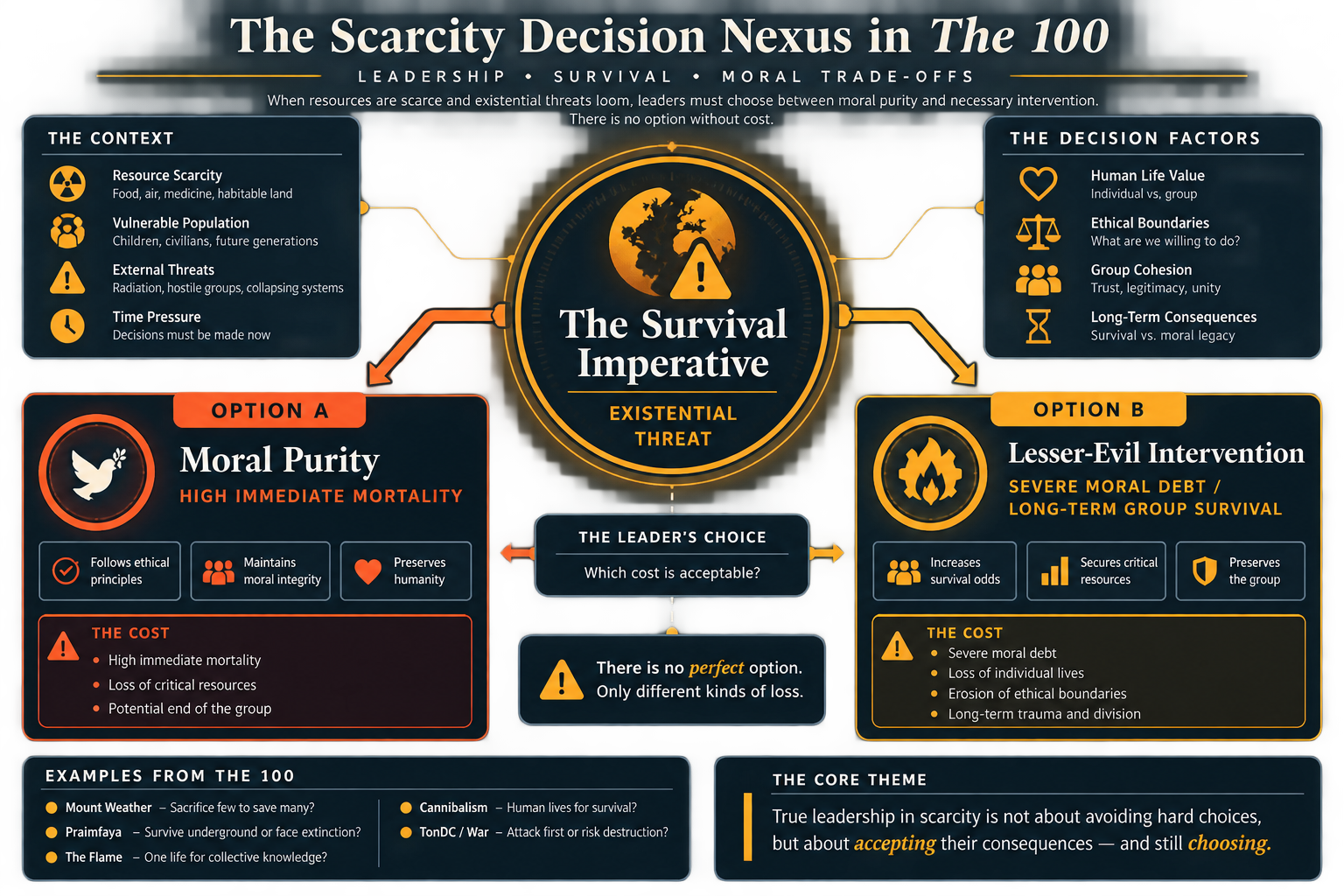
“There are no good guys. You can't survive without carrying the cost of your choices.”
2. What the Series Understands About Moral Injury
The most interesting decisions in The 100 are not difficult because the correct answer is hidden. They are difficult because every available answer violates something the characters value. Clarke repeatedly saves a group by accepting a burden that separates her from it. Bellamy’s loyalty becomes both his strength and the doorway through which fear can manipulate him. Octavia turns survival into identity until the role begins to consume the person beneath it.
Across the seasons, the series asks whether repeated emergency can excuse permanent cruelty. Its characters often say that there was no choice, yet the consequences continue to shape alliances, grief, and self-understanding long after the immediate crisis ends. Survival does not close the moral account.
The later seasons sometimes escalate so quickly that reflection struggles to keep pace with spectacle. Even so, the ending returns to the question beneath the entire series: if humanity survives by abandoning everything humane, what exactly has been preserved?
The character arc I kept thinking about
Octavia’s movement between belonging, violence, authority, exile, and reconciliation gives the series its clearest picture of how survival roles can harden—and how identity can still change.