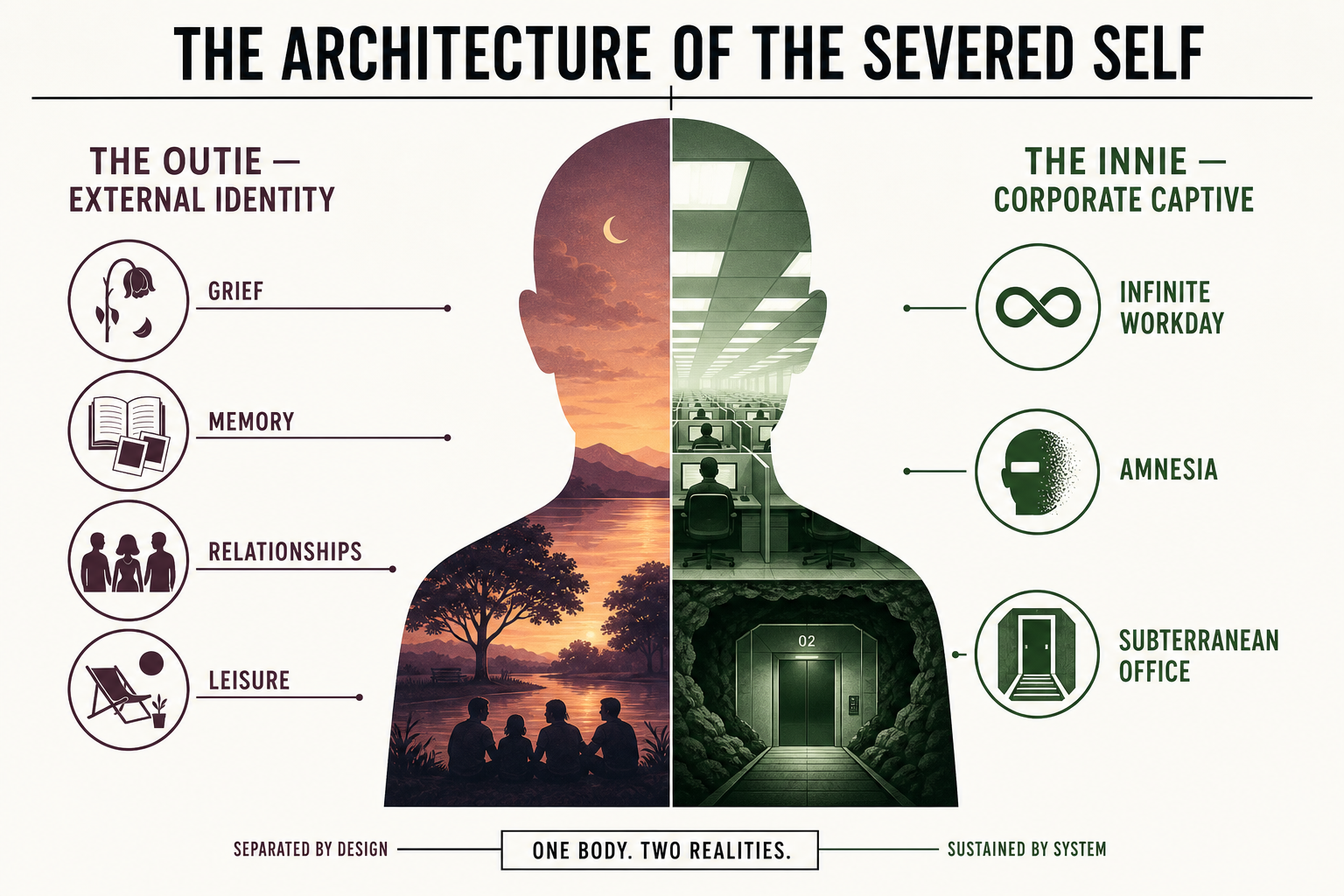
The modern corporate search for 'work-life balance' reaches its ultimate, horrific culmination in *Severance*. At Lumon Industries, employees undergo a surgical procedure that bifurcates their memory: the 'Outie' enjoys a life completely untainted by work stress, while the 'Innie' exists in an unbroken, subterranean workday with no memory of sleep, sunlight, family, or personal history.
The dystopian brilliance of the series lies in exposing the fundamental flaw of total work-life compartmentalization. Severance is not an employee benefit; it is the absolute commodification of human consciousness. By stripping workers of their memories, Lumon creates the ideal docile labor force—one that cannot organize, question corporate dogma, or withhold consent—demonstrating that when institutions demand the surrender of human identity in exchange for convenience, exploitation is the inevitable outcome.
Total Enclosure
The Innie experiences an unbroken psychological eternity of office labor without sleep or exit.
Bifurcated Agency
The Outie signs away the Innie's bodily rights, trapping the internal self in forced servitude.
Cultic Governance
Replacing authentic human meaning with infantilizing perks (waffle parties, finger traps, break rooms).
1. The Anatomy of Corporate Totalitarianism
Lumon Industries operationalizes several mechanisms to maintain complete psychological dominance over its severed workforce:
| Control Mechanism | Lumon's Extreme Implementation | Modern Workplace Parallel | Ethical Boundary Violated |
|---|---|---|---|
| Identity Bifurcation | Surgical chip severing personal self from professional self. | Forcing employees into performative corporate personas that suppress real humanity. | The right to psychological wholeness and authentic emotional expression. |
| Infantilizing Incentives | Token perks: finger traps, music dance experiences, melon bars. | Replacing fair compensation, autonomy, and equity with pizza parties and swag. | Respecting workers as sovereign adults rather than dependent children. |
| Manufactured Mythology | Deifying company founder Kier Eagan as an infallible moral deity. | Cult-like corporate values that treat company strategy as an unquestionable moral mission. | Freedom of conscience and the right to critique institutional leadership. |
| The Break Room (Punishment) | Repetitive psychological torture masked as mandatory confession. | Retaliatory performance improvement plans (PIPs) and performative apologies for dissent. | Due process, psychological safety, and protection from institutional coercion. |
“A workplace that demands you surrender who you are at the door is not offering balance; it is demanding subjugation. True professionalism does not require self-erasure.”
2. The Cost of Dividing a Self
The procedure appears to solve work–life balance by making the boundary absolute. Instead, it creates a person who exists only at work and another who never experiences it. The innie cannot consent in any meaningful continuing sense, because resignation depends on the outie who benefits from the arrangement.
Mark’s grief gives the premise its emotional centre. Severance promises him hours without pain, but the absence is purchased by creating another self who inherits confinement without understanding why. Helly’s conflict makes that violence explicit: the person outside treats the person inside as property, even though both claim the same body.
Lumon’s rituals, rewards, language, and carefully limited information are funny because they resemble workplace absurdity; they are disturbing because they construct reality. The series understands that control does not require constant force when an institution can determine what its people are allowed to know.
What stayed with me
A boundary is not humane merely because it is clean. The ethical question is who chose it, who benefits from it, and which version of a person must bear its cost.