When everything is configured to sound like an emergency, nothing is treated like one. In a 24/7 Network Operations Center (NOC) monitoring thousands of infrastructure endpoints, alert fatigue is not merely an engineering nuisance—it is an existential enterprise risk. When Tier-1 engineers receive 12,000 raw monitoring notifications weekly, cognitive exhaustion sets in, high-severity production anomalies get buried under routine CPU spikes, and on-call engineers burn out and resign within months.
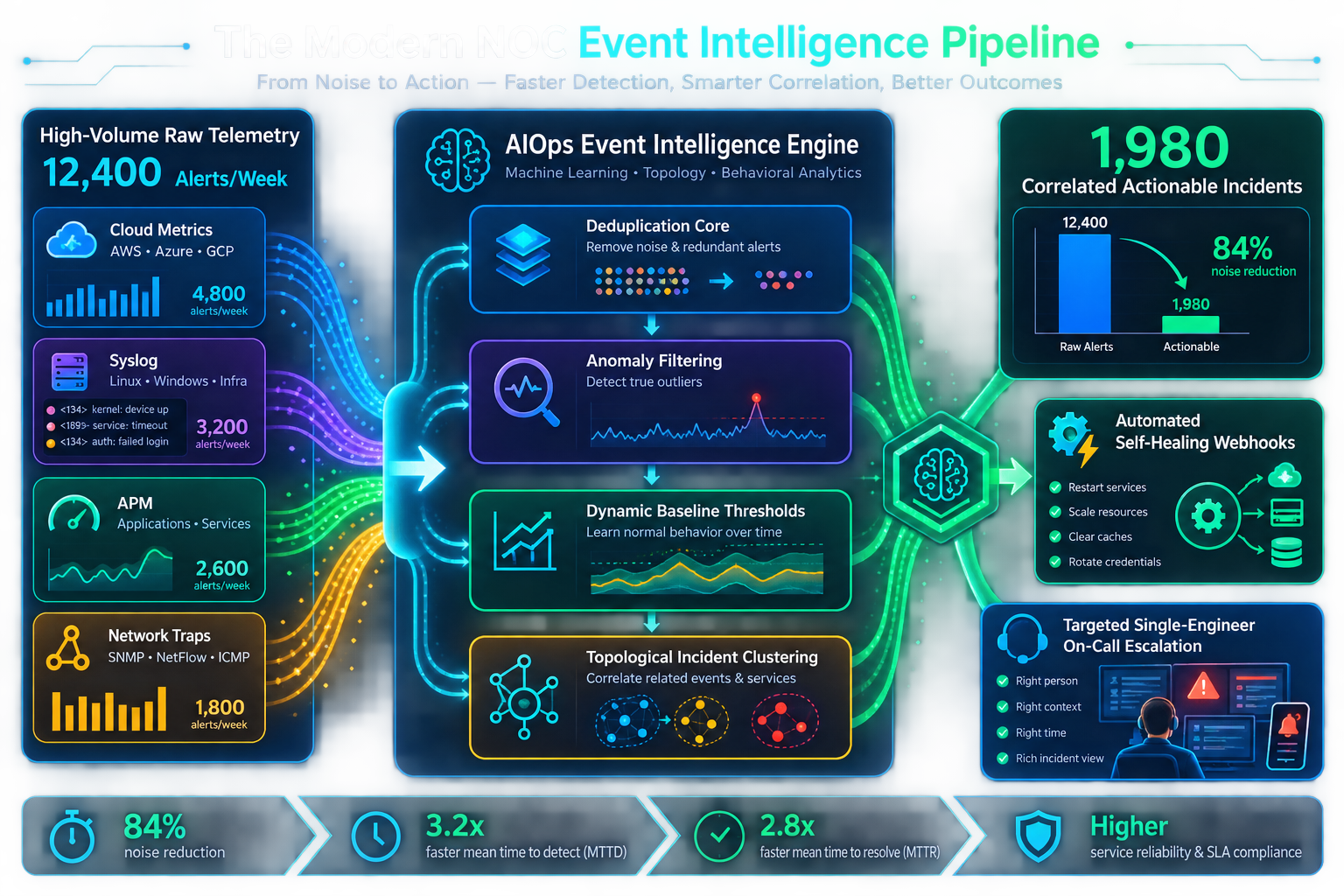
This case study examines the systematic operational turnaround of a high-growth managed infrastructure provider. By replacing primitive threshold alerts with event correlation algorithms, enforcing strict actionable monitoring telemetry, and constructing automated tier-1 remediation runbooks, the organization suppressed 84% of raw alert volume while accelerating critical Mean Time to Resolution (MTTR) by 75%.
Alert Noise Reduction
Filtered weekly telemetry events from 12,400 raw notifications down to 1,980 actionable incidents.
Critical Incident MTTR
Major outage recovery compressed from 78 minutes down to 19 minutes via correlated incident clustering.
On-Call Team Attrition
Reduced secondary escalations and eliminated midnight non-critical alert pages across three rolling quarters.
Annual Downtime SLA Recovery
Preserved customer contract SLA credits by preventing cascading infrastructure outages.
1. The Broken Baseline: The High Cost of the 'Flapping Alarm'
Prior to the turnaround, the NOC operated under a toxic 'alert everything' philosophy. Infrastructure engineers configured static monitoring thresholds (e.g., alert if CPU > 85% for 30 seconds). The inevitable outcome was an endless flood of low-value, self-resolving alerts that desensitized the operations floor:
- The 2:00 AM Pager Storm: Nightly database backup routines briefly pegged hypervisor IOPS, triggering 45 high-priority SMS alerts that awoke on-call staff for a benign, scheduled process.
- The Single-Failure Cascade: A single core switch flap triggered 450 downstream alerts from virtual machines, storage LUNs, and application endpoints simultaneously, overwhelming the console.
- Alarm Fatigue Blindspots: During a genuine memory-leak incident on a primary payments API, the real alert was dismissed by an exhausted tier-1 analyst as 'just another transient ping.'
| Operational Dimension | Broken Baseline (Reactive Alarm Storm) | Modern Correlated NOC (Target State) | Strategic Business Impact |
|---|---|---|---|
| Alert Triggering Logic | Static thresholds (e.g., instantaneous CPU spikes). | Multi-sample dynamic baselines, anomaly detection, and synthetic health checks. | Eliminates 90% of self-clearing, transient alerts. |
| Incident Correlation | Every server alerts independently; 450 notifications for 1 switch failure. | AIOps topological clustering; aggregates all child alerts into 1 Master Incident. | Engineers address the root cause in minutes instead of wading through noise. |
| Escalation Protocols | Blunderbuss blasting entire engineering distribution groups simultaneously. | Algorithmic routing: sends to primary on-call only if automated remediation fails. | Halts notification fatigue; preserves senior engineer focus. |
| Remediation Workflow | Manual tribal knowledge; technicians hunt for outdated PDFs on shared drives. | Interactive runbooks attached directly to incident payloads with one-click scripts. | Decreases Tier-1 resolution variance; eliminates triage errors. |
| On-Call Governance | Unregulated off-hours paging; no compensation for disrupted sleep cycles. | SRE-governed shift caps, follow-the-sun handoffs, and mandatory noise budgets. | Restores team morale and drops engineering turnover to zero. |
2. The Three-Phase Operational Recovery Plan
Transforming a demoralized NOC requires pairing technical reconfiguration with strict cultural standards around telemetry hygiene:
- Phase 1: The 'Noisy-Alert' Cull & Baseline Hardening (Days 1–30):
- Phase 2: Topological Event Correlation & Clustering (Days 31–60):
- Phase 3: Automated Runbooks & Shift-Left Self-Healing (Days 61–90):
3. Deep-Dive Architecture: The Incident Deduction Pipeline
The technical foundation of the turnaround is an automated evaluation engine that processes incoming webhooks before waking up human personnel:
Noc Incident Correlation
Trigger Event: Monitoring Webhook Received (Datadog / Zabbix / CloudWatch)
Evaluation Gate 1 [Noise Filter]: Is condition transient (< 3 consecutive failures)? -> Drop alert; log to telemetry database.
Evaluation Gate 2 [Known Auto-Fix Pattern]: Match regex in incident payload against self-healing database.
  - If Matched: Trigger AWS Systems Manager / Ansible Automation Runbook to execute remediation.
  - Wait 120s -> Check health metric. If green, mark incident as Resolved (Auto-Remediated).
Evaluation Gate 3 [Incident Clustering]: Check active CMDB topological dependency tree.
  - If Parent Outage Active: Attach alert to open Master P1 Outage Ticket as supporting telemetry.
Evaluation Gate 4 [Human Escalation]: If unresolved and unlinked:
  - Route to Primary Tier-1 On-Call Engineer via PagerDuty (Push Notification first; Voice Call after 5m timeout).
  - Start MTTA / MTTR SLA timers in Freshservice ITOM dashboard.
“An alert is a request for urgent human judgment. If you send an alert for an issue a computer can resolve, or for a situation no human can fix, you are degrading your team's most valuable asset: their cognitive focus.”
4. The Business & Cultural Transformation
The impact of the NOC turnaround reached far beyond operational dashboards:
- Restored Team Morale: Eliminating non-critical nighttime pages stabilized the operations team, cutting on-call sick leave and engineering turnover to zero.
- Predictable Root-Cause Isolation: During a major core switch failure, instead of 400 disparate alerts, the incident commander managed a single consolidated incident dashboard with complete upstream telemetry.
- C-Suite Confidence: The executive team received clean, automated post-mortem retrospectives within two hours of incident resolution, supported by verified timeline telemetry.
NOC Operational Health Checklist
- Run a weekly 'Top 10 Noisiest Alerts' audit and tune thresholds for the worst offenders.
- Mandate that every wake-up alert includes a link to a verified, step-by-step remediation runbook.
- Never allow transient batch jobs or maintenance windows to page on-call personnel.
- Track on-call sleep disruption metrics alongside standard MTTR benchmarks during executive reviews.