Resilience in modern corporate discourse is often trivialized into hollow motivational slogans. In *Man's Search for Meaning*, Viktor Frankl provides a rigorous, unsentimental counterweight: a clinical and philosophical exploration of human endurance drawn from surviving concentration camps and developing logotherapy.
Frankl’s core insight is that human motivation is not primarily driven by the pursuit of pleasure or power, but by the search for meaning. Even when external autonomy is entirely stripped away, individuals retain the agency to determine their internal stance toward circumstances. Adversity does not automatically build character; rather, personal responsibility and purposeful orientation determine whether suffering leads to despair or profound internal strength.
Foundational Freedom
The capacity to govern one's internal perspective regardless of external constraints.
Sources of Purpose
Finding meaning through creative contribution, human connection, and courage during unalterable crises.
The Primary Inquiry
Reframing life from what we demand from the world to how we answer the responsibilities before us.
1. The Three Pathways to Meaning
Logotherapy outlines three primary avenues through which individuals can build a grounded sense of purpose, even during systemic disruption:
| Pathway | Operational Focus | Applied Context | Psychological Shift |
|---|---|---|---|
| Creative & Productive Work | Delivering tangible value through craft, engineering, or creation. | Building reliable infrastructure, authoring systems, solving critical problems. | Moving from passive reception to active, deliberate contribution. |
| Relational Connection & Beauty | Experiencing deep connection with others, nature, or art. | Mentorship, authentic team solidarity, appreciative inquiry. | Recognizing value outside self-centered utility and transactions. |
| Stance Toward Inevitable Challenge | Choosing dignity, patience, and resolve when facing unalterable hardship. | Navigating irreversible system failures, organizational crisis, or personal loss. | Converting unavoidable hardship into an occasion for ethical integrity. |
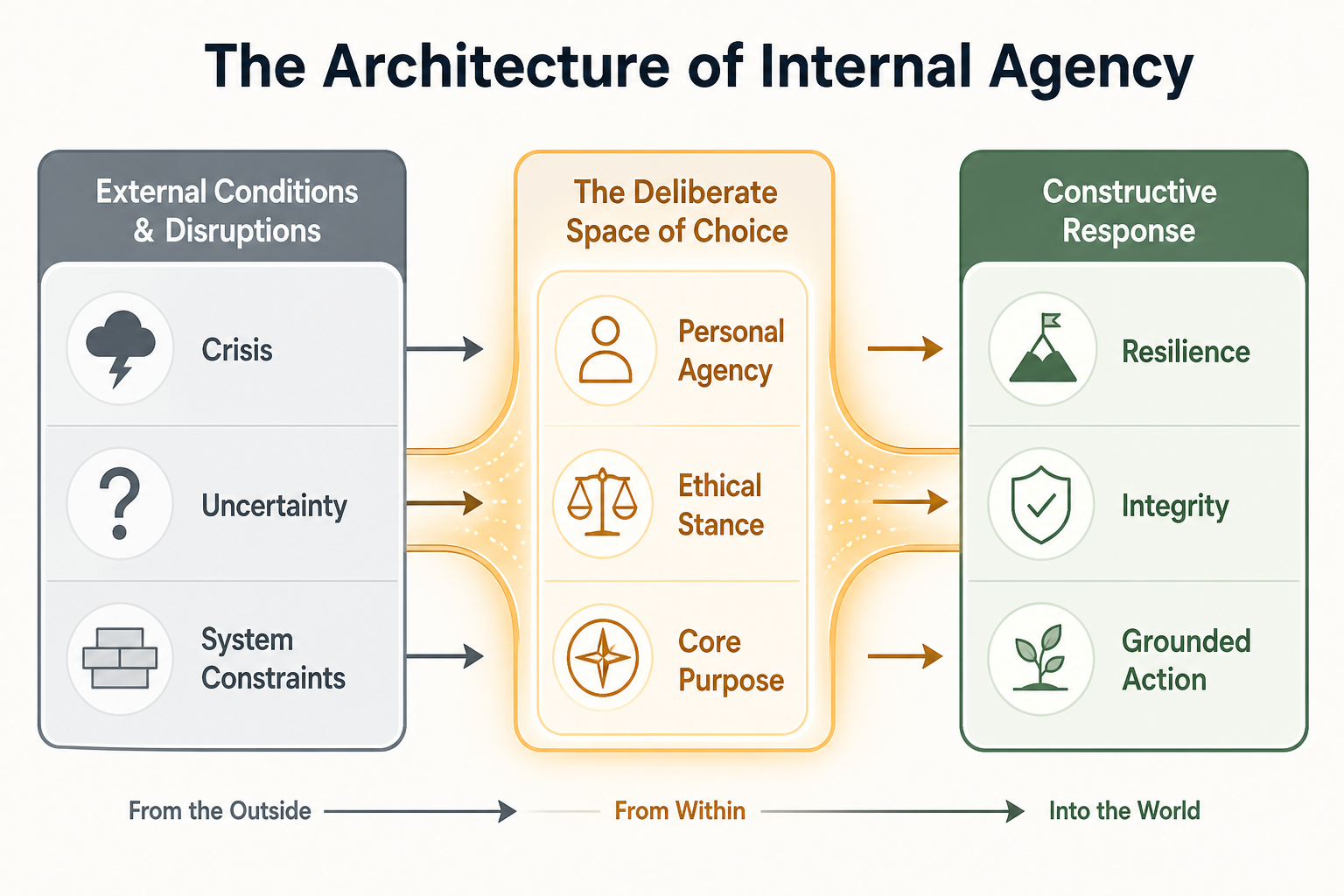
“True resilience is not the absence of difficulty, but the conscious decision to anchor one's actions in purpose and personal accountability when circumstances turn hostile.”
2. Meaning Without Turning Suffering Into a Lesson
Frankl’s insistence on an inner freedom is powerful, but it needs careful reading. The book does not make suffering desirable, nor does it suggest that pain automatically produces wisdom. Much suffering is simply destructive. Meaning is not a reward guaranteed to the person who endures enough.
What the book offers is narrower and more humane: even when circumstances remove almost every choice, a person may still search for a response that preserves some relationship to dignity, love, work, memory, or responsibility. That possibility should never be used to judge someone whose pain has overwhelmed them.
The memoir and the psychological argument also cannot be separated. Frankl’s ideas carry weight because they emerge from testimony, but no short framework can contain the historical reality through which they were formed. The book deserves to be read slowly, without extracting its sentences as motivational slogans.
A line of reflection
Meaning may not explain why suffering happened. Sometimes it is simply the thread that helps a person continue after explanation has failed.