In low-maturity IT organizations, heroism is celebrated. The engineer who logs in at 2:00 AM on a Sunday to manually bounce a crashed SQL server cluster is treated as a savior. In reality, persistent heroics are not a sign of operational excellence—they are symptoms of systemic architecture failure and unsustainable operating culture.
A 24/7 reliability culture replaces reactive firefighting with engineering discipline. By establishing explicit Error Budgets, sustainable follow-the-sun or tiered on-call rotations, and blameless operational reviews, organizations transition from constantly fixing broken systems to engineering systems that fail safely and recover autonomously.
Max Pager Duty per Week
Maximum sustained reactive interrupt time per on-call engineer shift.
Engineering SRE Allocation
Minimum team time reserved for automation and permanent problem elimination.
Mean Time to Assemble (MTTA)
Time from critical incident trigger to active engineering bridge mobilization.
1. The Cultural Shift: Heroism vs. Reliability Engineering
Transitioning to an SRE-inspired operating model requires fundamentally altering organizational incentives and operational measurements:
| Operating Dimension | The Reactive Hero Culture (Fails) | The 24/7 Reliability Culture (Sustained) |
|---|---|---|
| Primary Value Metric | Total ticket resolution volume closed per shift. | Mean Time to Recovery (MTTR) and Error Budget stability. |
| Incident Response | Ad-hoc manual triage by whichever engineer answers first. | Automated PagerDuty escalation policies with codified incident commander roles. |
| Post-Mortem Cadence | Punitive blame search targeting individual human error. | Blameless root-cause analysis focusing on system vulnerabilities and telemetry gaps. |
| On-Call Sustainability | Uncompensated burnout shifts resulting in engineer turnover. | Bounded on-call compensation with mandatory rest periods after overnight pages. |
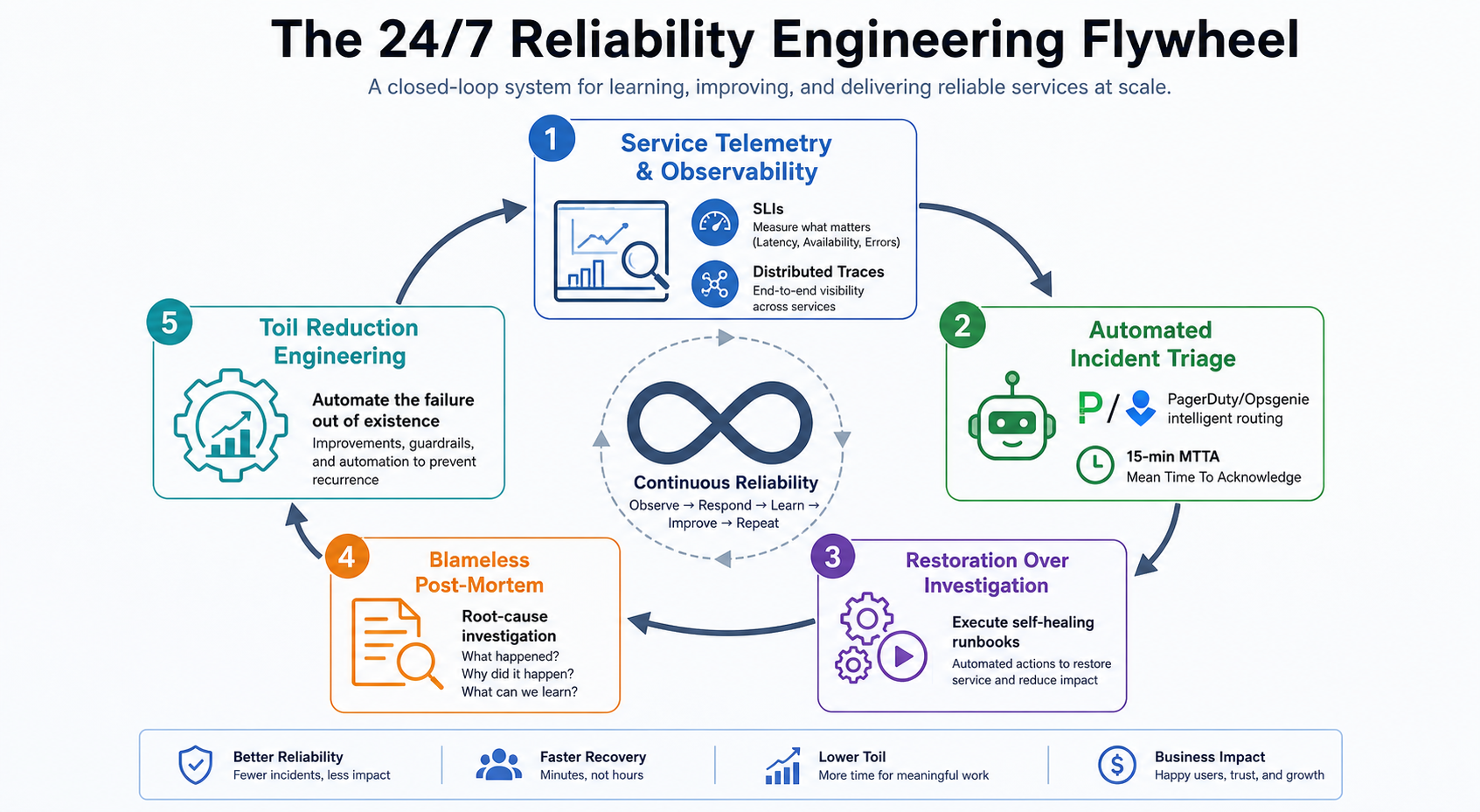
“If an engineer must wake up at 2:00 AM to perform an action that a script could execute, your systems are not operating under technical governance; they are operating on borrowed human capital.”
2. The Error Budget Governance Framework
Error Budgets bridge the inherent tension between development velocity and operational stability. If an infrastructure service promises a 99.9% Service Level Objective (SLO), it has an allowable downtime of 43.8 minutes per month.
- Healthy Error Budget (> 25% Remaining): Feature releases, major infrastructure migrations, and non-critical updates proceed normally.
- Depleted Error Budget (< 25% Remaining): All non-security feature deployments freeze immediately; 100% of engineering bandwidth pivots to reliability fixes, automated testing, and infrastructure stabilization.
On-Call Health Audit Checklist
- Enforce a strict policy: Any alert firing outside business hours must represent a customer-impacting P1 outage requiring immediate human intervention.
- Mandate comp time / late starts for any engineer engaged in an overnight escalation lasting longer than 45 minutes.
- Track Toil Ratio monthly: Ensure repetitive manual tasks consume less than 35% of engineering team bandwidth.