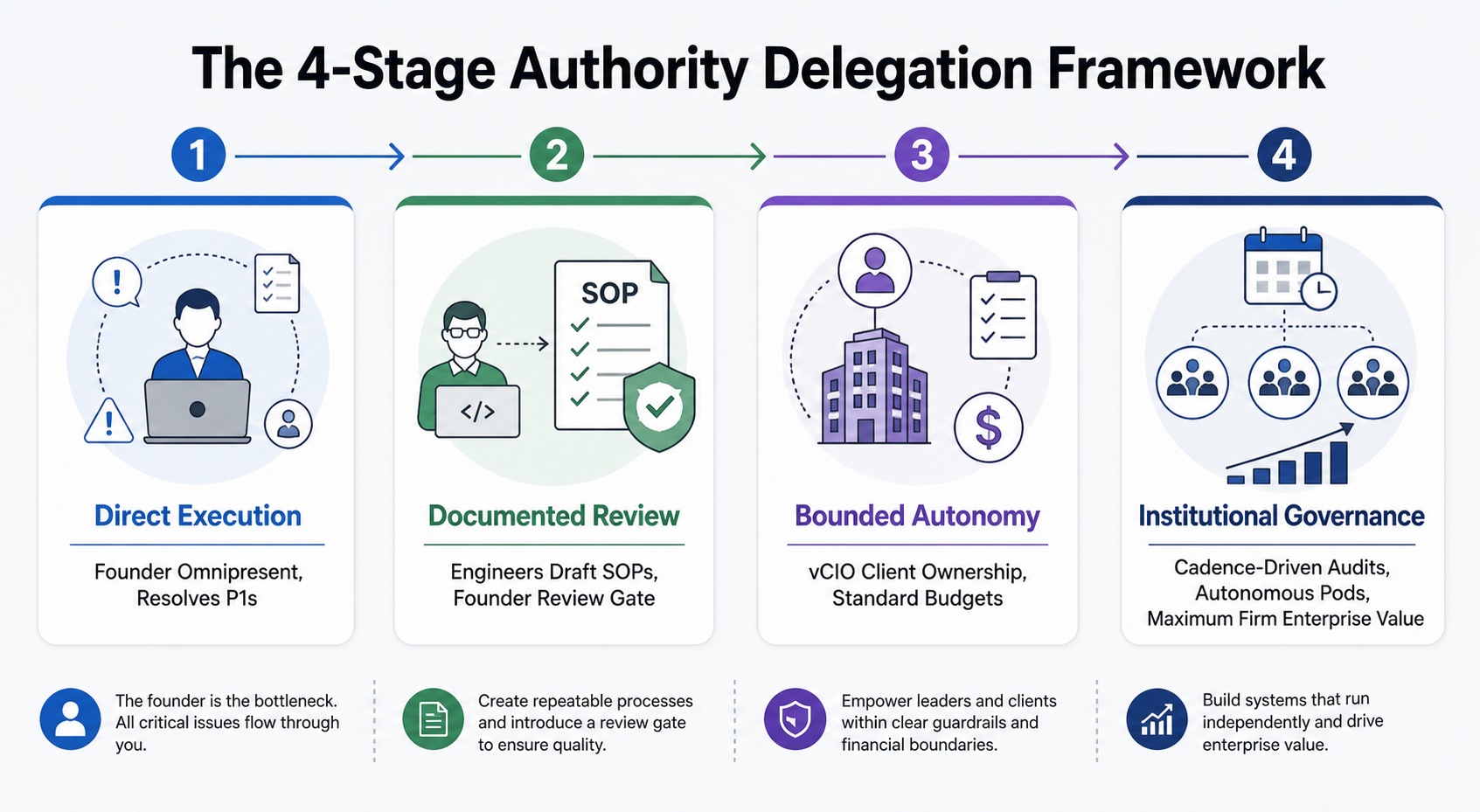
Every successful IT managed service provider begins as a reflection of its founder's personal drive, engineering brilliance, and client relationship mastery. However, the exact traits that propel an MSP from $0 to $2M in revenue—founder omnipresence, bespoke client promises, and ad-hoc fire-fighting—become the primary constraints preventing scale beyond $5M.
Transitioning from founder-led delivery to an institutional management system does not mean disempowering the founder. Rather, it requires encoding the founder's tacit judgment into operational telemetry, decision-rights frameworks, and repeatable management cadences that operate autonomously.
Founder Autonomy Window
Ability for daily service delivery to run without executive ticket intervention.
Account Ownership Transfer
Tier 1 & 2 client relationships managed exclusively by dedicated vCIOs.
First-Touch Runbook Resolution
Frontline tickets resolved using codified standard operating procedures.
1. The Three Structural Bottlenecks of Founder Dependency
To liberate executive bandwidth for strategic enterprise partnerships and acquisitions, leadership must methodically dismantle three core operational bottlenecks:
- The Technical Escalation Trap: Service desk technicians routing unusual or complex tickets directly to the founder via chat instead of following governed escalation trees.
- The Relational Account Trap: Clients insisting on speaking exclusively with the founder for routine billing inquiries, hardware approvals, or minor performance concerns.
- The Bespoke Quoting Trap: Every prospective statement of work requiring custom founder pricing calculations rather than standardized service tier catalog selections.
“If your business cannot run smoothly for forty-five days without your active intervention in daily service tickets, you do not own an enterprise; you own a high-stress technical job.”
2. Operational Cadence Over Constant Supervision
A durable management system replaces unpredictable ad-hoc interventions with structured, repeatable governance routines:
| Governance Routine | Cadence | Participants | Primary Telemetry Focus |
|---|---|---|---|
| Daily Triage Standup | Daily (15 mins) | Service Desk Leads & NOC Leads | SLA risk detection, queue unblocking, and P1 status review. |
| Operational Health Audit | Weekly (45 mins) | Service Manager & Lead Architect | Tech utilization, noise index trends, recurring incident patterns. |
| Commercial Margin Review | Monthly (60 mins) | Leadership & Account Leads | Account gross margin, project realization rate, and true-ups. |
| CoE Strategy & Standards | Quarterly (Half-day) | Practice Leads & Executives | Golden Master baselines, automation backlog, vendor evaluations. |
Succession Legitimacy Checklist
- Introduce vCIOs and service delivery managers during strategic quarterly planning sessions, never during reactive support crises.
- Transfer quoting authority to a standardized commercial catalog with fixed margin floors.
- Implement strict communication boundaries directing all client support requests through official portal and ticketing channels.