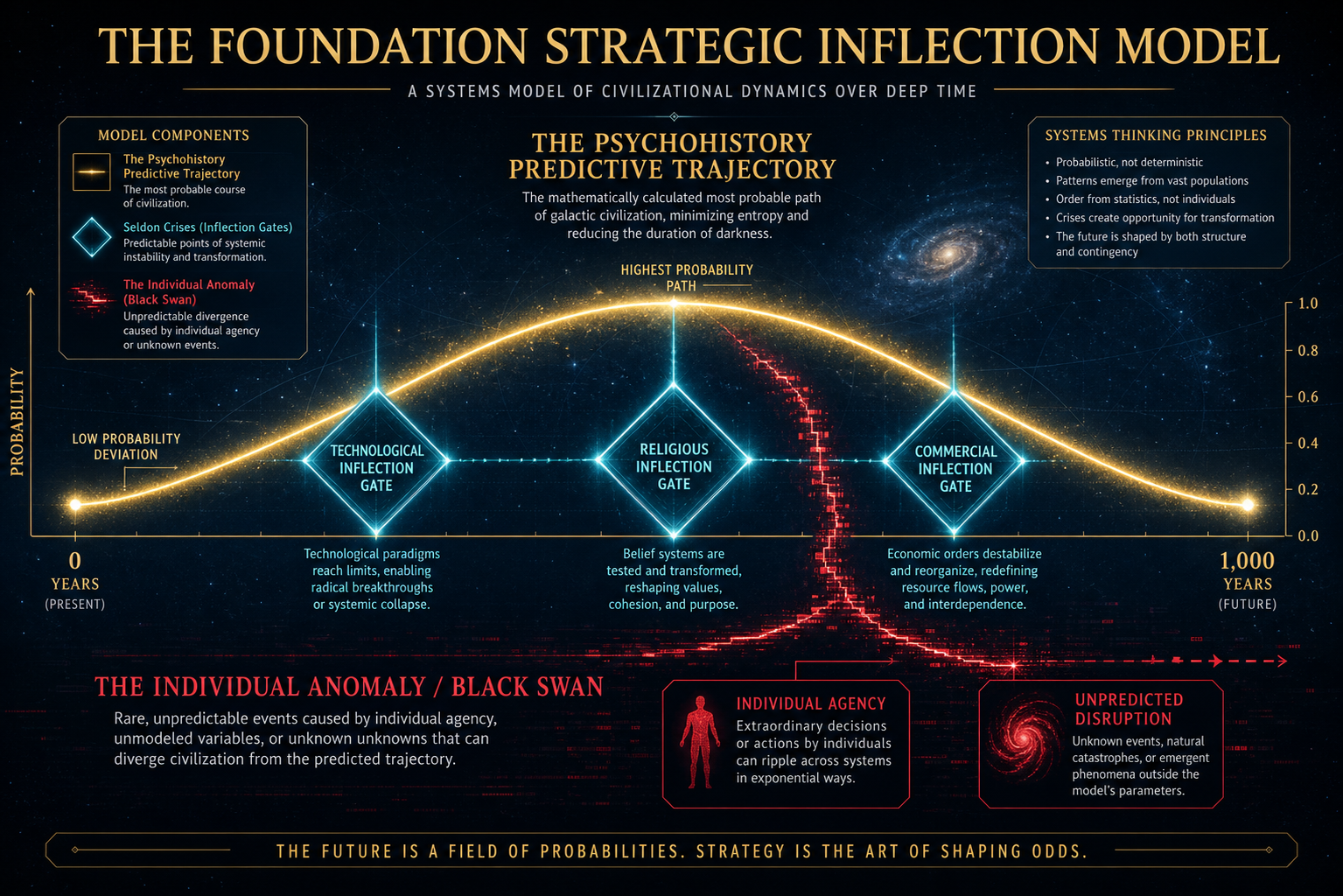
Most corporate strategic roadmaps collapse the moment real-world friction disrupts the baseline forecast. In *Foundation*, mathematician Hari Seldon introduces Psychohistory—a statistical model capable of predicting the broad sociological movements of quadrillions of humans across millennia. Recognizing the inevitable fall of the Galactic Empire, Seldon establishes the Foundation to shorten the ensuing dark age from thirty thousand years to a single millennium.
The enduring strategic value of *Foundation* lies in the continuous tension between macro-level deterministic forecasting and the messy reality of individual human agency. Seldon’s grand mathematical model accurately maps the systemic decay of an over-centralized, stagnant empire. However, as the Seldon Crises unfold, the Foundation survives not by blindly adhering to an immutable ancient script, but because adaptable frontline leaders recognize when dynamic local interventions must bridge the gaps in the theoretical model.
Strategic Optimization
Compressing 30,000 years of chaotic barbarism into a managed transition.
Macro-Data Modeling
Statistical laws governing massive populations, inherently blind to individual anomalies.
Inflection Gates
Critical historical pivot points where systemic pressures force inevitable structural resets.
1. Imperial Stagnation vs. Adaptive Foundation Strategy
The galactic conflict contrasts the rigid, self-replicating inertia of the Genetic Dynasty against the lean, knowledge-driven evolution of the Foundation:
| Strategic Domain | The Cleonic Empire (Rigid Inertia) | The Foundation (Adaptive Evolution) | Modern Enterprise Lesson |
|---|---|---|---|
| Leadership Continuity | Cloning the exact same emperor for centuries (Genetic Dynasty). | Decentralized succession governed by knowledge and crisis leadership. | Monoculture in leadership breeds blindness to emerging market disruptions. |
| Response to Anomaly | Denies systemic decay; executes dissidents to preserve appearance of control. | Analyzes crisis indicators as predictable evolutionary inflection points. | Treating negative signals as operational data rather than public relations threats. |
| Technological Posture | Hoards stagnant, unmaintained legacy mega-technologies. | Miniaturizes, optimizes, and iterates functional core technologies. | Massive technical debt collapses under maintenance overhead; modular agility survives. |
| Strategic Planning | Assumes permanent hegemony; zero adaptation to external shifts. | Prepares for systemic collapse; builds redundancy across distributed nodes. | Resilient organizations design for industry reset rather than infinite status quo. |
“Violence is the last refuge of the incompetent. True power lies in understanding the structural currents of history and positioning your systems so the inevitable works in your favor.”
2. Prediction Versus Human Agency
Psychohistory gives Foundation its grand intellectual hook: large populations may be statistically predictable even when individuals are not. The series repeatedly complicates that promise through singular people—Gaal, Salvor, Hari, Demerzel, and the Cleons—whose loyalties and deviations reshape what the plan appears to require.
The genetic dynasty provides the strongest counter-image. Empire tries to defeat uncertainty by reproducing the same ruler, yet repetition does not prevent change. Each Cleon is shaped by different relationships, fears, and historical pressures. Continuity becomes performance rather than stability.
The series sometimes lets spectacle crowd out the patience its ideas deserve, and its timelines demand attention. At its best, it treats prediction as a political force: people behave differently once they believe a future has been scientifically authorised.
The idea I kept returning to
A plan designed for centuries still has to pass through individuals who experience only one lifetime—and who may refuse the role assigned to them.