Most Service Level Agreements (SLAs) are designed for legal protection rather than operational excellence. When contracts focus exclusively on arbitrary response times, engineers learn to game the system—sending automated 'Ticket Received' emails within 15 minutes to stop the SLA clock while the client's production system remains hard down for twelve hours.
SLAs shape operational behavior. To drive genuine service improvement, an agreement must separate Response Time, Restoration Time, and Final Resolution Time, while incorporating Experience Level Agreements (XLAs) that reflect real business impact rather than superficial ticket metrics.
Target MTTR (P1)
Mean time to restore critical business workflow functionality.
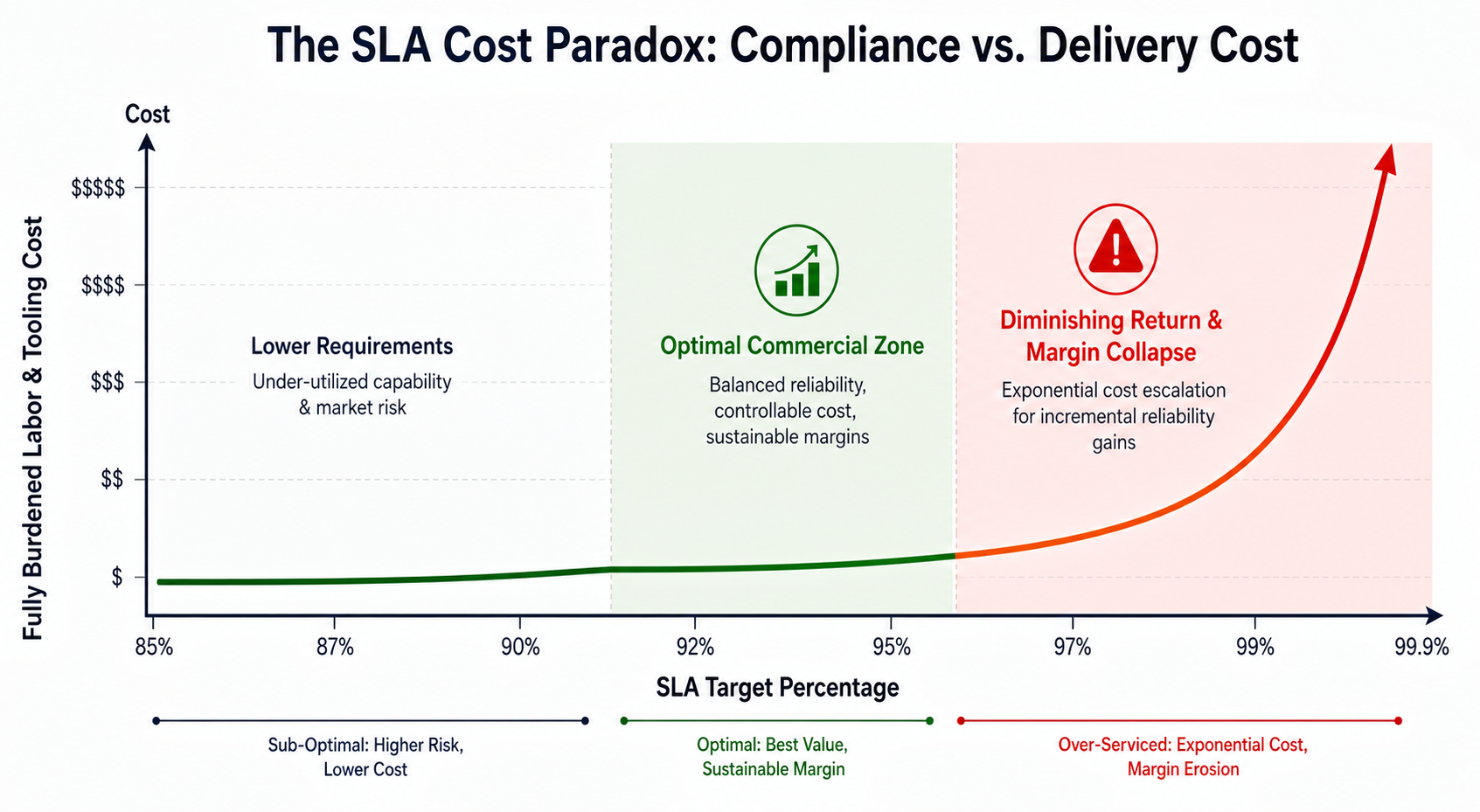
The Cost-SLA Sweet Spot
Optimal SLA target balancing capital efficiency against exponential 99%+ staffing costs.
Target XLA Score
Customer sentiment and friction index measured independently of ticket speed.
1. The Three Layers of Operational Timers
A high-performing service organization tracks three distinct operational timers for every incident:
| Metric Dimension | Operational Definition | Target Objective | How Engineers Game It If Poorly Designed |
|---|---|---|---|
| Time to Acknowledge (TTA) | Time from ticket creation to active human triage. | < 15 mins (P1/P2) | Firing generic automated macro replies without reviewing incident details. |
| Time to Restore (TTR) | Time to return the business workflow to functional state. | < 60 mins (P1) | Cannot be gamed; measured directly by business service availability. |
| Time to Resolve (TTC) | Time to complete permanent root-cause fix and close ticket. | < 5 business days | Prematurely closing tickets while workarounds remain active in production. |
“Clients do not care how quickly you open an email; they care how quickly they can get back to processing payroll and billing their customers. Measure restoration, not acknowledgment.”
2. Transitioning from SLAs to Experience Level Agreements (XLAs)
An organization can maintain 99.5% SLA compliance while client satisfaction collapses if the underlying technology experience is fraught with micro-frictions. Incorporating XLAs ensures operational delivery tracks sentiment alongside technical telemetry:
- Transactional Sentiment Audits: 1-click sentiment requests triggered only on meaningful ticket resolutions, capturing friction scores.
- Device Health XLAs: Tracking endpoint crash frequencies and boot times to resolve chronic performance degradation before tickets are filed.
- Business Outage Multipliers: Applying contractual credit penalties to restoration duration during peak transactional hours rather than off-peak windows.
SLA Restructuring Checklist
- Eliminate generic automated email auto-responders from stopping SLA response timers.
- Rewrite contracts to define P1 SLAs based on Functional Restoration rather than Permanent Root-Cause Resolution.
- Implement an explicit Priority Matrix based on Business Impact (Company-wide down vs single user) and Urgency.