A green checkmark on a backup dashboard simply proves that data was copied to a secondary disk; it does not prove that your organization can recover from a ransomware attack or infrastructure failure.
True Business Continuity and Disaster Recovery (BCDR) is measured by validated restoration time, verified workload dependencies, and immutable storage isolation. Designing for recoverability requires engineering backwards from maximum acceptable business downtime rather than forwards from backup software features.
Target RTO
Maximum validated time to restore core transactional services to production status.
Target RPO
Maximum permissible transactional data loss between snapshot intervals.
Immutability
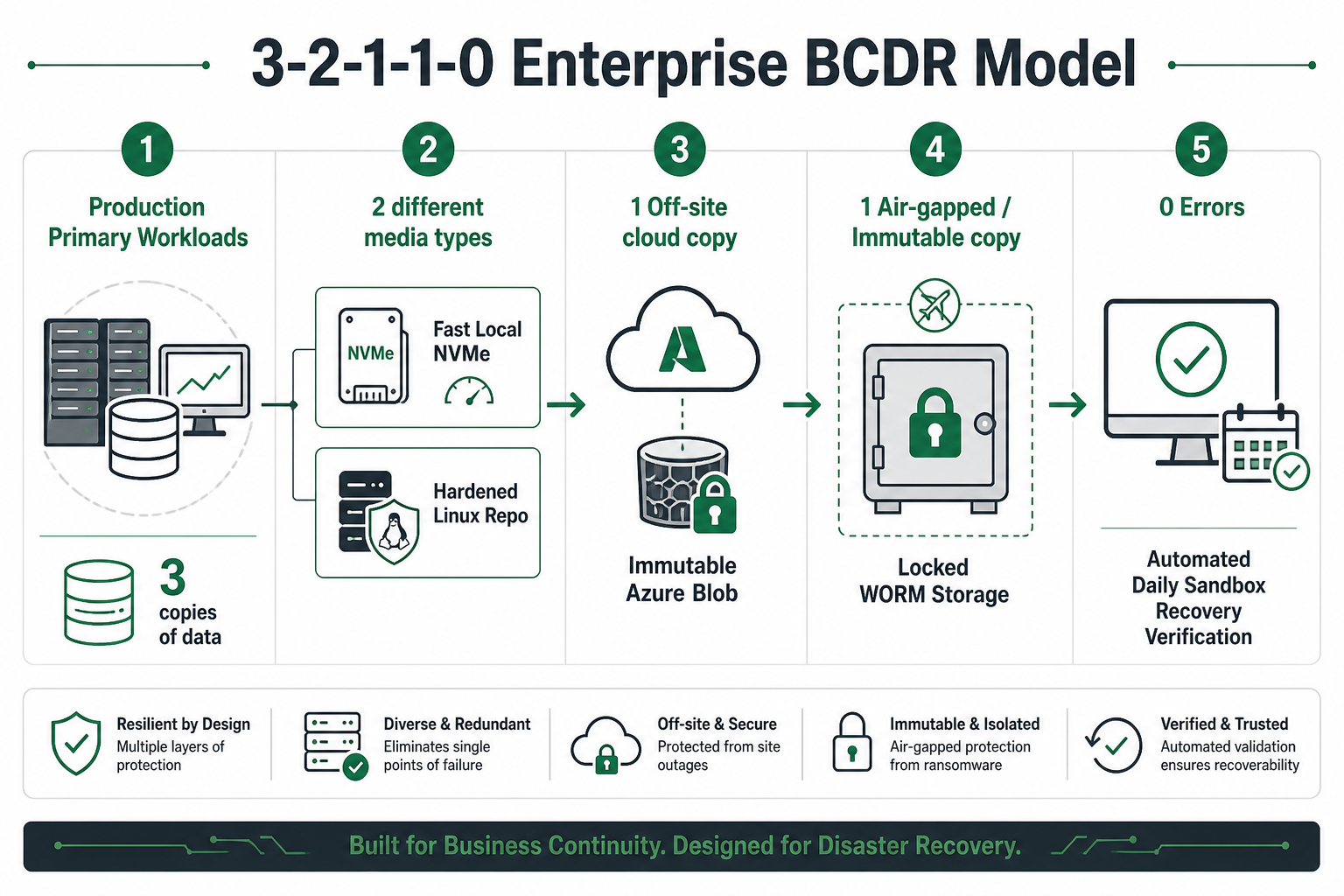
Backups locked with WORM compliance preventing deletion even by compromised admin accounts.
1. The Difference Between Backups and Recoverability
| Operational Dimension | The Hope-Based Approach (Vulnerable) | The Engineered BCDR Capability (Resilient) |
|---|---|---|
| Verification Method | Daily email backup success notification. | Automated sandbox boot-testing and screenshot verification (Veeam SureBackup). |
| Storage Architecture | Local NAS with domain-joined network shares. | Hardened Linux repository with immutable WORM storage and air-gapped cloud copies. |
| Dependency Mapping | Restoring servers individually in arbitrary order. | Sequenced orchestration: Identity (DC/DNS) -> Database (SQL) -> Application -> Frontend. |
| Testing Cadence | Annual theoretical paper review. | Quarterly full failover simulation to isolated virtual networks. |
“An untested backup does not exist. It is merely an expensive hypothesis waiting to be disproven by a crisis.”
2. The Dependency-Sequenced Restoration Pipeline
During a catastrophic recovery event, restoring servers out of order causes service crashes and database corruption. A mature recovery plan executes in strict dependency sequence:
- Tier 0 (Core Identity & Network): Domain Controllers, Entra Connect agents, DNS servers, and internal PKI infrastructure.
- Tier 1 (Stateful Database Engines): SQL Server clusters, Oracle backends, and storage volume mounts.
- Tier 2 (Application & Middleware): Line-of-business application services, web APIs, and integration middleware.
- Tier 3 (Client Presentation Layer): Virtual desktop hosts (AVD), reverse proxies, and external client gateways.
BCDR Operational Mandates
- Remove all backup storage repositories from Active Directory domain trust boundaries.
- Enforce four-eyes approval and multi-factor authentication for any backup deletion request.
- Conduct quarterly live disaster recovery rehearsals measuring true recovery time against SLA commitments.