The ability to perform deep work is becoming increasingly rare at the exact same time that it is becoming increasingly valuable in our economy. In *Deep Work*, Cal Newport argues that modern open-plan offices, instant-messaging tools, and performative responsiveness have fragmented human attention, reducing knowledge workers into frantic routers of trivial information.
High-value technical craftsmanship—architecting complex systems, writing elegant software, diagnosing elusive incidents, and mastering hard concepts—requires long, unbroken stretches of intense concentration. Shallow work (answering emails, attending status calls, scrolling chats) keeps you busy, but deep work is the only engine that creates enduring economic value.
Daily Deep Work Limit
Maximum daily capacity of high-intensity cognitive concentration for a trained expert.
Cognitive Switching Tax
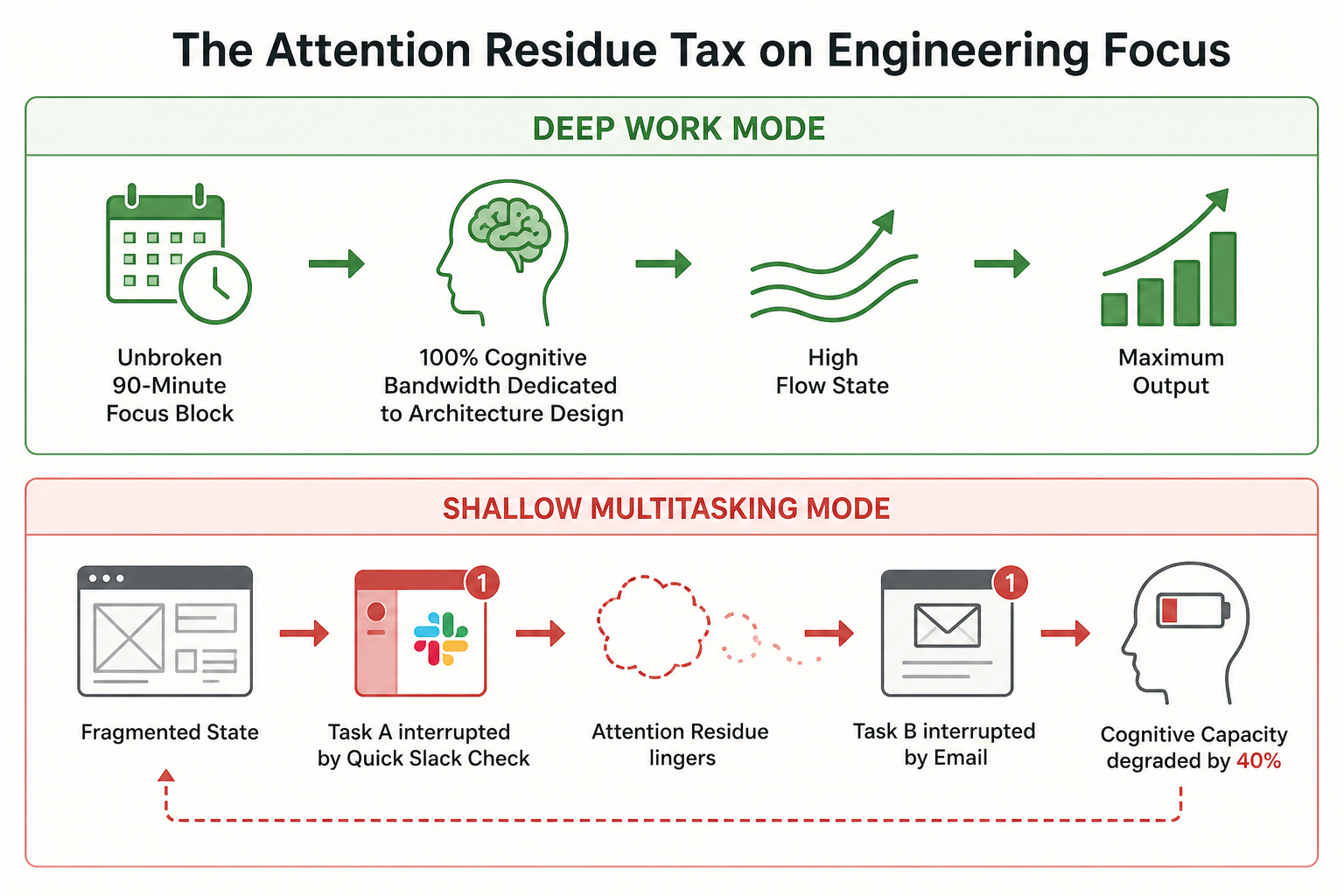
Checking an inbox leaves a cognitive residue that degrades performance on subsequent tasks for 20+ minutes.
The Law of Productivity
High-Quality Work Produced = (Time Spent) x (Intensity of Focus).
1. Deep Work vs. Shallow Work: The Economic Chasm
| Work Dimension | Deep Work (High Value) | Shallow Work (Low Value) | Economic Consequence |
|---|---|---|---|
| Cognitive Demands | Intellectually demanding activities performed in a state of distraction-free focus. | Logistical, non-cognitively demanding tasks performed while distracted. | Deep work creates new value and is hard to replicate; shallow work is easily outsourced or automated. |
| Tooling & Habits | Long-form writing, deep code synthesis, architecture design, offline thinking. | Constant Slack checking, infinite email triage, performative 15-minute sync meetings. | Deep work builds rare technical mastery; shallow work produces cognitive exhaustion with zero output. |
| Attention State | Zero context switching; singular cognitive immersion. | Fragmented attention residue jumping between screens every 3 minutes. | Multi-tasking reduces effective cognitive capacity and spikes anxiety. |
“If you do not produce, you will not thrive. If you do not learn hard things quickly, you will not produce. And deep work is the core capability required to learn hard things quickly.”
2. The Four Deep Work Scheduling Philosophies
- The Monastic Philosophy: Radical elimination of shallow obligations (isolating oneself entirely from incoming communications).
- The Bimodal Philosophy: Dividing time into distinct deep work periods (e.g., 2 days completely offline, 3 days for meetings/admin).
- The Rhythmic Philosophy (Most Practical for Leaders): Establishing a rigid, predictable daily rhythm (e.g., 8:00 AM to 11:30 AM reserved strictly for deep focus before opening email).
- The Journalistic Philosophy: Shifting instantly into deep work mode whenever a 90-minute gap appears in the calendar (requires high mental training).
Attention Protection Checklist
- Schedule every minute of your workday in advance using time-blocking, treating deep work blocks as unmovable commitments.
- Quit social media and eliminate all non-essential notification banners from desktop and mobile screens.
- Embrace boredom: Stop reaching for your phone during every 30-second elevator ride or micro-pause to retrain your brain for focus.