Therapy language has entered the mainstream, and with it, a widespread misunderstanding of boundaries. Today, people routinely weaponize boundary terminology to justify cold stonewalling, enforce rigid emotional control over partners, and avoid the vulnerable discomfort of authentic communication.
A boundary is not a wall designed to keep people out, nor is it a rulebook designed to dictate someone else's behavior. A boundary is the clear, compassionate definition of what you need in order to remain open, loving, and connected within a relationship without sacrificing your integrity.
Boundary Locus of Control
A real boundary defines your own actions and limits, not your partner's behavior.
Non-Coercive Metric
Real boundaries offer choices with natural consequences, never ultimatums.
Connection Index
Healthy boundaries are communicated with warmth to preserve connection.
1. Healthy Boundary vs. Controlling Demand vs. Emotional Wall
| Interpersonal Dynamic | Core Intent | Example Statement | Relational Consequence |
|---|---|---|---|
| Authentic Boundary | Clarifies personal limits and defines personal self-care action. | "If voices are raised during arguments, I will step outside for 15 minutes to cool down." | Fosters safety, mutual respect, and de-escalation. |
| Controlling Ultimatums (Misnamed Boundary) | Attempts to police, restrict, or dictate the partner's choices. | "My boundary is that you are not allowed to meet your friends on weekends." | Breeds resentment, loss of autonomy, and eventual rebellion. |
| Emotional Wall (Defense Mechanism) | Shuts down communication to avoid vulnerability and intimacy. | "I'm not discussing this topic ever. Deal with it yourself." | Produces chronic emotional loneliness and relational death. |
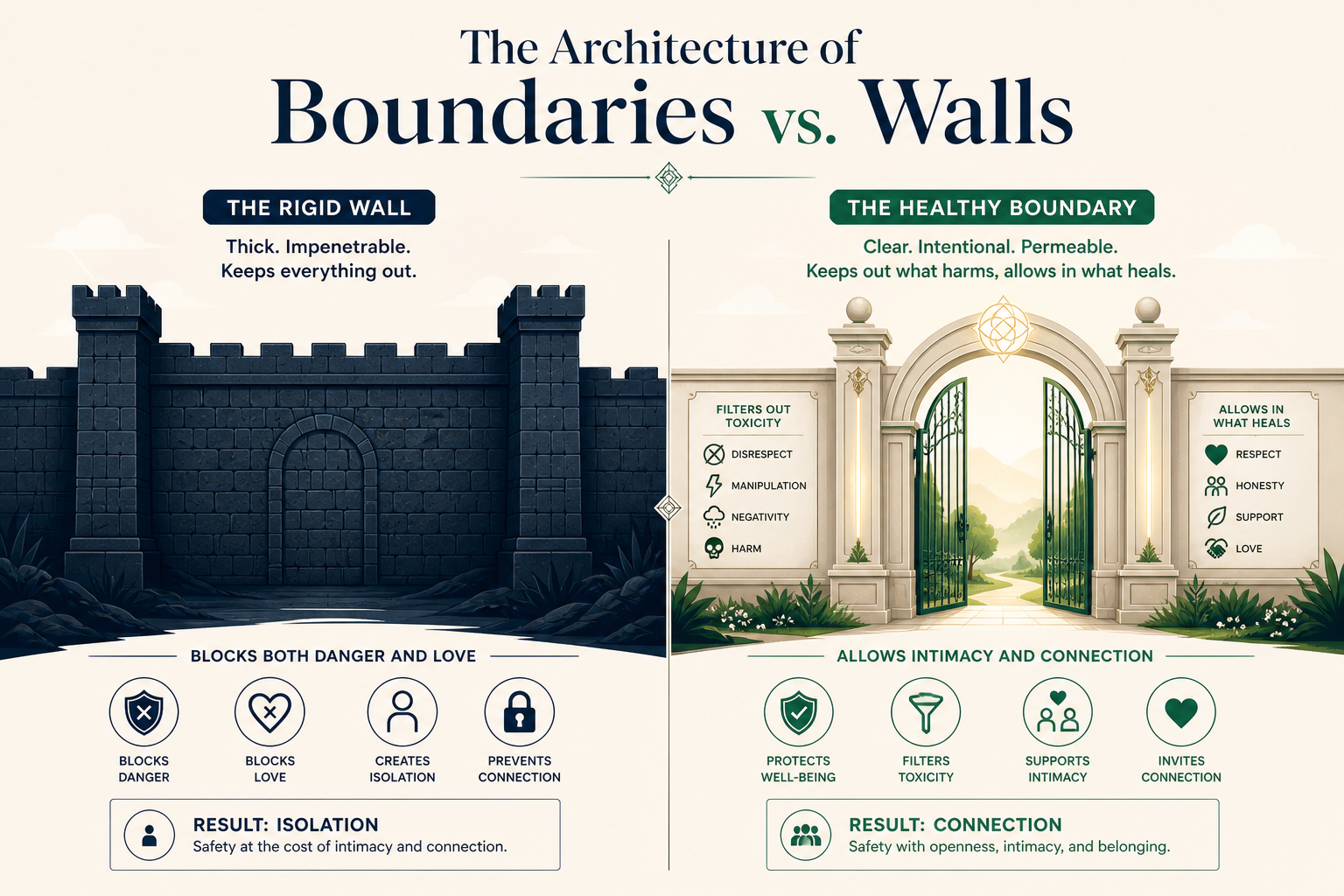
“A boundary tells someone: 'This is where I end and you begin, and this is what I will do to stay in healthy relationship with you.' A wall simply says: 'I refuse to be seen.'”
2. The Anatomy of a Clean Boundary Statement
A mature boundary formula contains three clear, non-punitive components:
- Statement of Condition: 'When [behavior or environmental dynamic occurs]...'
- Definition of Personal Action: '...I need to [take this specific self-care action]...'
- Reaffirmation of Connection: '...so that [we can reconnect safely / I can show up with respect].'
Boundary Integrity Checklist
- Ensure your boundary focuses 100% on your own response, not your partner's compliance.
- Communicate boundaries during calm, neutral moments—never during the heat of an active fight.
- Remember that someone who benefits from your lack of boundaries will always label your new boundary as 'selfish'.