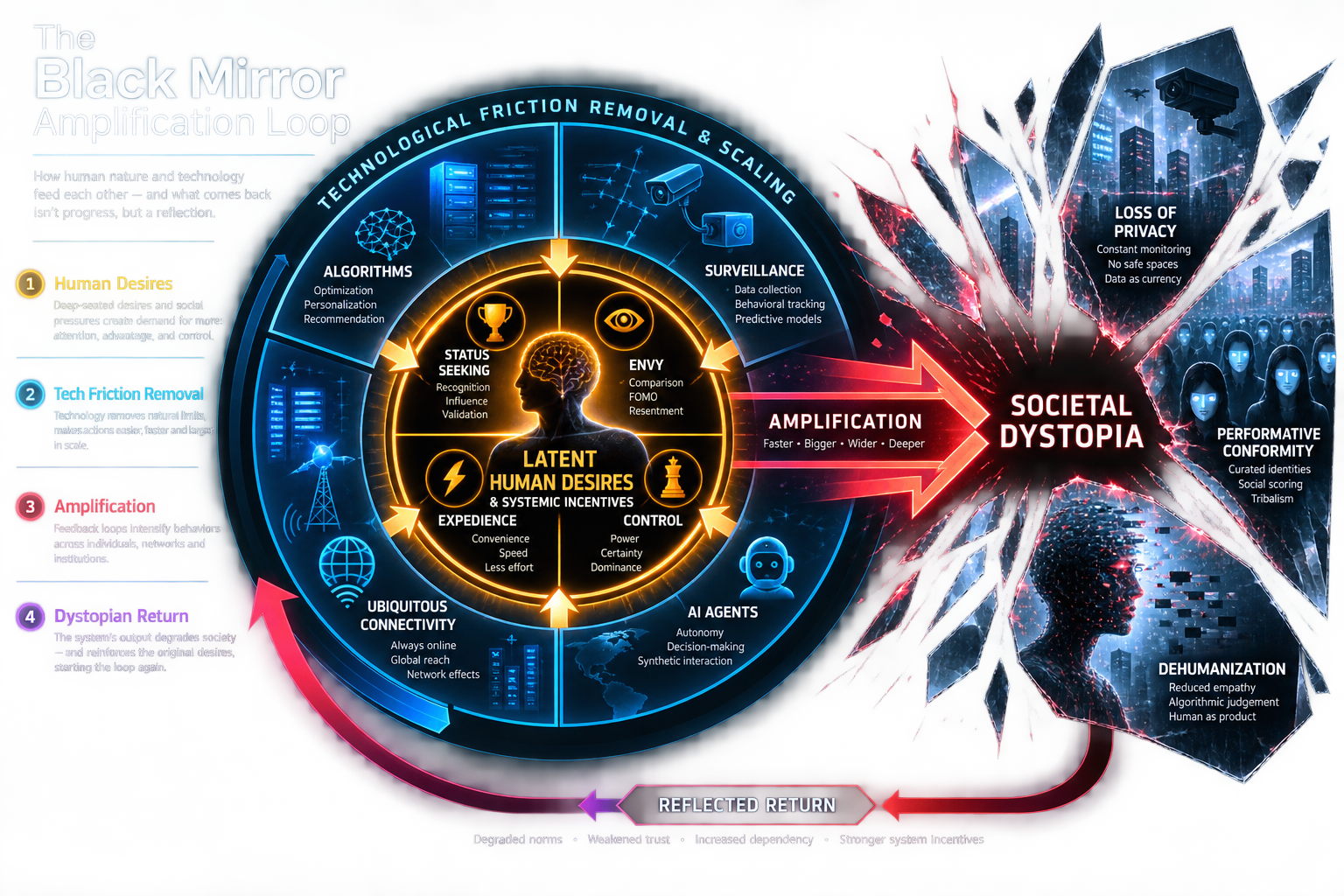
Popular discourse often treats emerging technology as an autonomous external monster—blaming artificial intelligence, algorithmic feeds, and ubiquitous monitoring for corrupting modern culture. *Black Mirror* systematically dismantles this lazy technophobia by demonstrating a harsher truth: technology is never the disease; it is merely an amplifier and mirror of unexamined human instincts, institutional incentives, and moral vulnerabilities.
From performative validation loops ('Nosedive') to unconstrained memory surveillance ('The Entire History of You') and outsourced digital labor ('White Christmas'), Charlie Brooker’s anthology reveals that technical systems do not invent cruelty, narcissism, or social policing. Instead, digital tools optimize, accelerate, and scale the latent desires and systemic compromises societies are already willing to make.
The Mirror Thesis
Digital architectures reflect and scale human incentives rather than generating independent desires.
Acceleration Risk
Removing social friction exposes humanity to the raw consequences of unchecked impulses.
Algorithmic Feedback
When systems optimize for metric engagement, human behavior conforms to the metric.
1. Deconstructing the Digital Mirror: Episode Case Studies
Examining core episodes highlights how technical architectures exploit specific human psychological vulnerabilities:
| Episode Focus | Technological Mechanism | Underlying Human Vulnerability | Societal & Architectural Impact |
|---|---|---|---|
| Nosedive | Real-time social credit rating and peer-to-peer micro-validation. | Desperate need for social approval and fear of status exile. | Hyper-performative conformism and complete loss of authentic individuality. |
| The Entire History of You | Retinal memory recording and instant high-definition playback. | Obsessive jealousy, inability to forgive, and demand for total certainty. | Total destruction of interpersonal trust and psychological closure. |
| White Christmas | Consciousness cloning (Cookies) for automated domestic management. | Willingness to dehumanize and exploit sentient labor for convenience. | Normalization of digital cruelty masked behind clean consumer user interfaces. |
| Hated in the Nation | Autonomous pollinator drone swarms weaponized via social hashtags. | Casual digital mob lynching and the illusion of consequence-free online malice. | Algorithmic weaponization of collective outrage resulting in real-world destruction. |
“If technology is a drug—and it does feel like a drug—then what precisely are the side-effects? This area—between delight and discomfort—is where Black Mirror is set. The 'black mirror' of the title is the one you'll find on every wall, on every desk, in the palm of every hand: the cold, shiny screen of a TV, a monitor, a smartphone.”
2. The Episodes That Make the Mirror Work
Nosedive is not frightening because social ratings are technically impossible; it is frightening because ordinary approval-seeking already shapes speech, friendship, and status. The technology merely makes the pressure visible and continuous. The Entire History of You turns perfect recall into emotional imprisonment, showing that more evidence does not automatically produce more trust.
Be Right Back is quieter and more painful. Its artificial reconstruction can reproduce patterns of language without restoring the shared unpredictability of a person. The episode understands that grief is not a missing-data problem. Hated in the Nation, meanwhile, connects frictionless outrage to collective responsibility: millions of small gestures can become an outcome no individual feels they caused.
The anthology occasionally mistakes bleakness for depth, and not every episode earns its final twist. At its best, however, Black Mirror refuses the comforting story that technology arrives from somewhere outside society. The device changes; the appetite for recognition, control, punishment, escape, and love is already here.
What the series made me notice
The most dangerous interface is often the one that turns a morally significant act into a gesture too small to feel consequential.