Relying on willpower and motivation to achieve meaningful change is an operational mistake. Motivation is a fleeting emotional state that vanishes under stress, fatigue, and distraction. In *Atomic Habits*, James Clear demonstrates that long-term transformation is the natural byproduct of environment design and compounding systems.
You do not rise to the level of your goals; you fall to the level of your systems. By shifting focus from outcome-based desires ('I want to write a book') to identity-based daily architectures ('I am a writer who writes 300 words every morning'), small, incremental 1% improvements compound into monumental achievements over time.
The 1% Rule
Getting 1% better each day compounds into a 37x improvement over 365 days.
Behavior Change Engine
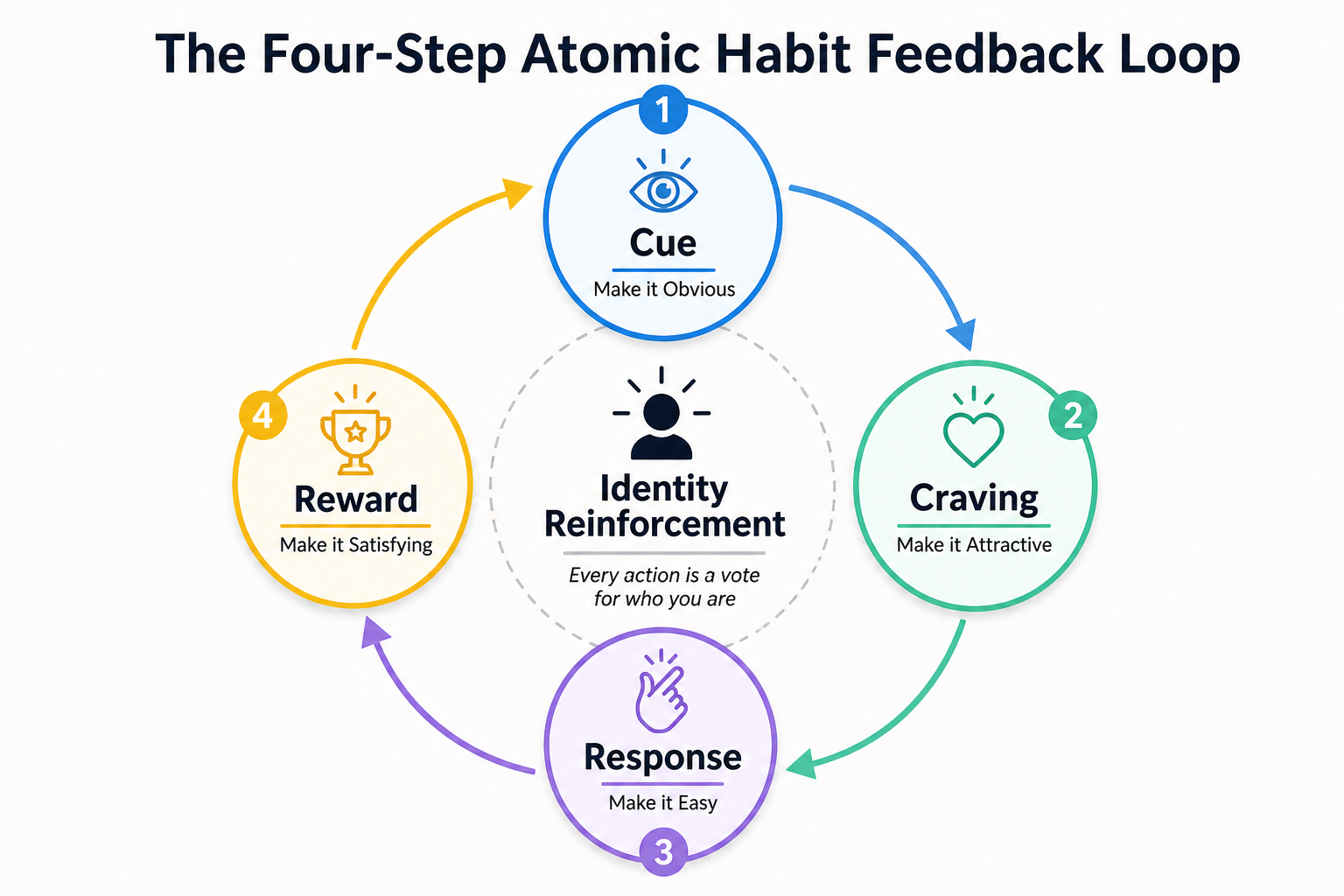
Make it Obvious, Make it Attractive, Make it Easy, Make it Satisfying.
Habit Architecture
Every action you take is a vote for the type of person you wish to become.
1. The Four Laws of Behavior Change
| Habit Stage | Building a Good Habit (The 4 Laws) | Breaking a Bad Habit (The Inversion) | Systemic Mechanism |
|---|---|---|---|
| 1. Cue (Trigger) | Make it Obvious: Implementation intentions & environment cues. | Make it Invisible: Remove triggers and friction from physical sight. | Visual cues dictate behavior more than internal motivation. |
| 2. Craving (Desire) | Make it Attractive: Temptation bundling with existing rituals. | Make it Unattractive: Reframe mindset and highlight long-term negative costs. | Dopamine spikes occur in anticipation of reward, not consumption. |
| 3. Response (Action) | Make it Easy: Reduce friction; enforce the 2-Minute Rule. | Make it Difficult: Increase friction; add physical barriers and gates. | Energy conservation is the default law of human behavior. |
| 4. Reward (Reinforcement) | Make it Satisfying: Immediate positive reinforcement & visual habit trackers. | Make it Unsatisfying: Accountability partners and public contracts. | What is immediately rewarded is repeated; what is punished is avoided. |
“You do not rise to the level of your goals. You fall to the level of your systems.”
2. Identity-Based Habits: Changing Beliefs Before Outcomes
- The Three Layers of Change: Outcomes (what you get) -> Processes (what you do) -> Identity (what you believe). True habit change is identity change.
- The Two-Minute Rule: When starting a new habit, scale it down to an action that takes less than two minutes (e.g., 'Read one page', 'Put on running shoes'). Master the art of showing up before optimizing.
- Environment Design Over Willpower: Do not rely on self-control to avoid distractions. Design your workspace and home so positive cues are obvious and negative temptations are physically difficult to reach.
- Never Miss Twice: Slips are inevitable; missing once is an accident, missing twice is the start of a new, negative habit.
Habit Architecture Audit
- What environment cues in your workspace trigger negative habits or digital distraction?
- Can you scale your most important daily habit down to a mandatory 2-minute starting ritual?
- Are your current daily routines casting votes for the identity you want to hold 5 years from now?